

Redefining the standard for ultra-sensitive and early MRD detection
Pathlight™ is a blood-based, multi-cancer MRD test that enables clinicians to monitor cancer progression from early detection through relapse and metastasis—supporting confident, informed treatment decisions at every stage of care.
Redefining the standard for ultra-sensitive and early MRD detection
Pathlight is a multi-tumor platform with its first indication in breast cancer delivering a >95% baseline detection rate at diagnosis across all stages and subtypes.
A personalized test powered by unparalleled knowledge of each tumor’s source code
Pathlight leverages digital PCR (dPCR) to target patient- and tumor-specific genetic fingerprints, enabling superior sensitivity and specificity.
Section: Print Background Text + Image
Order a test
Work with us to provide your patients trusted insights and guidance throughout their cancer journey.
MODULES: BUTTONS
Row: Headline and Text
Breaking barriers in clinical performance
Pathlight is driving a new era of oncology patient care. In a pivotal paper published in Clinical Cancer Research, Pathlight delivered 100% sensitivity, 100% specificity, and a 13.5 month lead time, a powerful advantage for detecting recurrence early.
Pathlight also breaks the 1ppm sensitivity barrier – enabling detection of early, small tumors while they’re still treatable – and predicts neoadjuvant response better than RCB or pCR.
Row: 2 Columns Text
Meeting the need for reliable monitoring throughout the cancer journey
Breast cancer is the most common malignancy among women, and the second leading cause of cancer death for women in the U.S.
70-75% of all breast cancers are estrogen receptor-positive (ER+), mostly diagnosed in stages I-III and considered “lower risk”. Yet up to 20–25% of early-stage ER+ patients experience recurrence, often years after treatment concludes and undetected by current MRD tools.
Clinicians need a way to reliably detect early molecular recurrence to monitor neoadjuvant treatment and risk prognosis guide decisionmaking about adjuvant or extended endocrine therapy, and assess evidence of disease post-surgery, providing patients with true reassurance or effective intervention when needed.
Row: Full text
Meeting the need for reliable monitoring throughout the cancer journey
Breast cancer is the most common malignancy among women, and the second leading cause of cancer death for women in the U.S.
70-75% of all breast cancers are estrogen receptor-positive (ER+), mostly diagnosed in stages I-III and considered “lower risk”. Yet up to 20–25% of early-stage ER+ patients experience recurrence, often years after treatment concludes and undetected by current MRD tools.
Clinicians need a way to reliably detect early molecular recurrence to monitor neoadjuvant treatment and risk prognosis guide decisionmaking about adjuvant or extended endocrine therapy, and assess evidence of disease post-surgery, providing patients with true reassurance or effective intervention when needed.
Row: 3 Columns Counter
%
sensitivity
month lead time
%
specificity
Row: 4 Columns Counter
%
overall baseline ctDNA detection
(94% ER+, 97.4% HER2+, 96% TNBC)
%
sensitivity for distant recurrence
(17/17)
%
specificity across all timepoints
(620/62)
months median lead time
(up to 1,931 days)
Section: 4 Columns Counter + Text + CTA
Unprecedented performance in clinical trials
In a pivotal study1, Pathlight demonstrates unmatched sensitivity, specificity, and prognostic utility for EBC patients.
Among 100 patients with Stage I–III EBC, Pathlight delivered 100% sensitivity, 100% specificity and a 13.5 month lead time, creating unparalleled opportunities for detecting recurrence early.
Pathlight also breaks the 1ppm sensitivity barrier, enabling the detection of early, small tumors while they’re still treatable, predicting neoadjuvant response better than RCB or pCR.
%
overall baseline ctDNA detection
(94% ER+, 97.4% HER2+, 96% TNBC)
%
sensitivity for distant recurrence
(17/17)
%
specificity across all timepoints
(620/62)
months median lead time
(up to 1,931 days)
Row: Image and Text

Fast answers.
Meaningful impact.
Every cancer diagnosis comes with unknowns. Pathlight offers invaluable comfort and guidance throughout the cancer journey.
From a simple blood or tissue sample, our next-generation MRD test quickly delivers true insights that enable better informed treatment decisions by physicians and patients.

Plasma results in 3-5 days; tumor fingerprint development in 2-3 weeks, for practical real-world use.
Validated across multiple cancer types including solid tumors and hematologic malignancies.
Proven in clinical studies including top-tier pharma companies and leading NCCN medical centers.
Row : Text and Image
Fast answers.
Meaningful impact.
Every cancer diagnosis comes with unknowns. Pathlight offers invaluable comfort and guidance throughout the cancer journey.
From a simple blood or tissue sample, our next-generation MRD test quickly delivers true insights that enable better informed treatment decisions by physicians and patients.
Plasma results in 3-5 days; tumor fingerprint development in 2-3 weeks, for practical real-world use.
Validated across multiple cancer types including solid tumors and hematologic malignancies.
Proven in clinical studies including top-tier pharma companies and leading NCCN medical centers.
Section: Text and Image with Background

A personalized test powered by unparalleled knowledge of each tumor's source code
First-generation MRD tests work by detecting single nucleotide variants (SNVs), which are susceptible to therapy selection pressure and can be lost over time to clonal variation.
Pathlight works differently, built on a proprietary database of patient-specific genetic alterations called structural variants (SVs), which are often at the root of tumorigenesis and metastatic progression.

Patient-specific and tumor-informed for more accurate detection and monitoring
Pathlight utilizes whole-genome sequencing of a patient’s tumor specimen to identify candidate structural variants unique to the patient and the tumor. This information is used to generate a personalized, ultra-sensitive multiplex digital PCR (dPCR) assay or “fingerprint,” used to detect the presence or absence of circulating tumor DNA (ctDNA) in blood.
Pathlight’s proprietary algorithm selects SVs that are less susceptible to therapy selection and clonal evolution, and enables more accurate tracking of response to therapy.

Section: Image and Text with Background

The Pathlight Difference
Most MRD tests struggle to exceed 80% detection rates. Pathlight’s proprietary algorithm detects stable, truncal biomarkers, enabling more precise tracking of a patient’s response to therapy, as well as post-surgical surveillance and monitoring of recurrence.
Instead of single nucleotide variants (SNVs), which are susceptible to therapy selection pressure, Pathlight conducts whole-genome sequencing of a patient’s tumor specimen to identify larger structural variants (SVs) that are easily amplified, enabling 100% specificity and sensitivity.
Row: Text and CTA with Orange Background
Order a Pathlight test
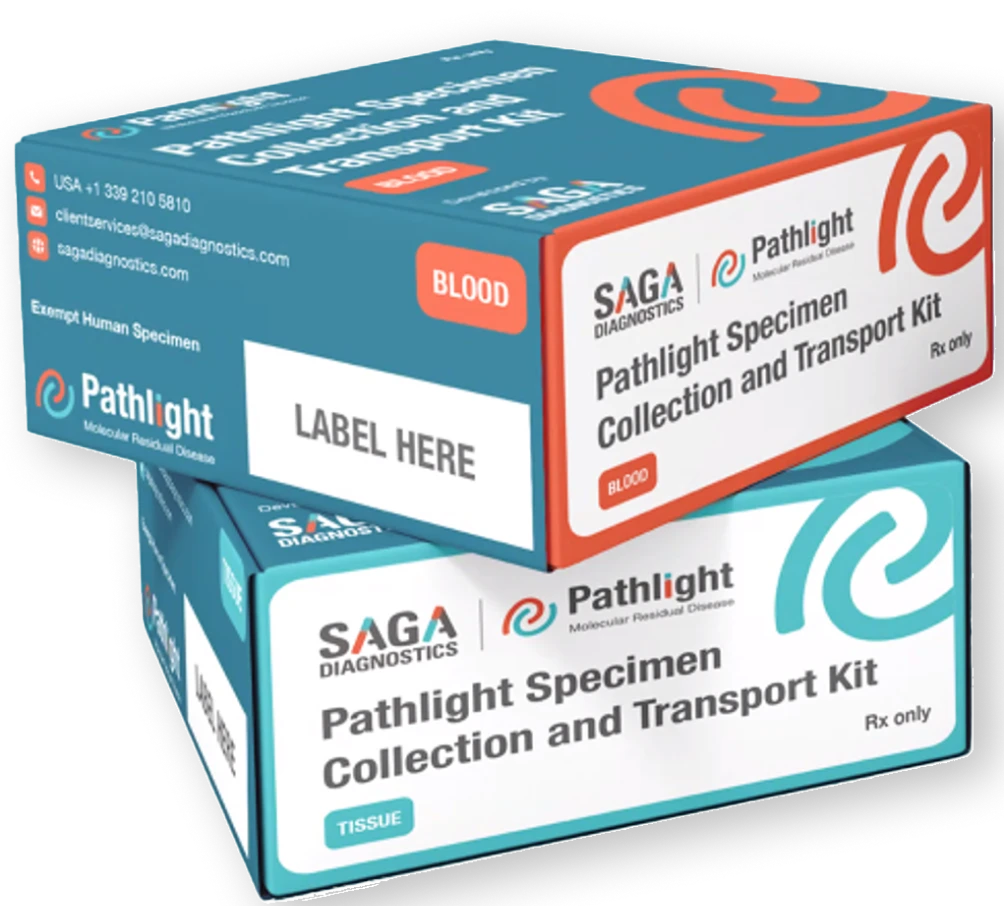
We’ll send you everything necessary to collect and analyze a blood or tissue sample.
Row: Text and CTA with Teal Background
Redefining the standard for MRD detection
We’ll send you everything necessary to collect and analyze a blood or tissue sample.
Section: Cards
Setting a new standard for MRD sensitivity and specificity
Pathlight overcomes one of the toughest challenges in oncology – the need for sensitive, specific, and earlier detection of MRD recurrence – providing key clinical insights and increasing the chances for successful treatment.

Ultra-sensitive detection
SVs often occur early in tumorigenesis and can be thoroughly amplified, resulting in more ctDNA fragments per genome, enabling greater sensitivity, fewer false negatives, and longer lead times.
Unparalleled specificity
SVs are rare, stable and uniquely specific to each patient and tumor, enhancing the specificity of MRD testing and reducing false positives.
No sensitivity cliff
NGS-based technologies have background error rates and hard sensitivity thresholds. Through a combination of whole genome SV biology and technology platforms, Pathlight has no such threshold, meaning every ctDNA signal will report a positive result.
MRD testing for every stage
Whether in early detection or late-stage metastatic monitoring, tracking therapeutic response or disease progression, Pathlight provides insights throughout the patient’s cancer journey, empowering clinicians to make informed treatment decisions.
Highly robust workflow
Pathlight results in a pass rate for plasma samples of >99.9% in published work by Elliott, Cescon and colleagues1, producing a successful fingerprint for ctDNA analysis in 95% of patients.
Row: Accordion
Frequently Asked Questions
(FAQs)
Is Pathlight covered by Medicare?
The total cost of the Pathlight test can vary depending on your insurance coverage, the medical indication, and any applicable copays or deductibles. We will work with your healthcare provider and insurance plan to determine your expected out-of-pocket cost before the test is performed. If you’re uninsured or underinsured, you may qualify for our Patient Assistance Program.
Your Title Goes Here
Your content goes here. Edit or remove this text inline or in the module Content settings. You can also style every aspect of this content in the module Design settings and even apply custom CSS to this text in the module Advanced settings.
Section: Video + Text
Super cool video
Lorem ipsum dolor sit amet, consectetur adipiscing elit. Etiam eu turpis molestie, dictum est a, mattis tellus. Sed dignissim, metus nec fringilla accumsan, risus sem sollicitudin lacus, ut interdum tellus elit sed risus. Maecenas eget condimentum velit, sit amet feugiat lectus. Class aptent taciti sociosqu ad litora torquent per conubia nostra, per inceptos himenaeos. Praesent auctor purus luctus enim egestas, ac scelerisque ante pulvinar.
Row: References
References
- Clin Cancer Res (2025) 31 (8): 1520–1532. https://doi.org/10.1158/1078-0432.CCR-24-3472
- Panet, F., Papakonstantinou, A., Borrell, M. et al. Use of ctDNA in early breast cancer: analytical validity and clinical potential. npj Breast Cancer 10, 50 (2024). https://doi.org/10.1038/s41523-024-00653-3
Vimeo
In this overview of the updated TRACER study, presented at SABCS 2025, Dr. Mitchell Elliott explains why structural variants (SVs) provide a robust “fingerprint” for cancer monitoring
Youtube
In this overview of the updated TRACER study, presented at SABCS 2025, Dr. Mitchell Elliott explains why structural variants (SVs) provide a robust “fingerprint” for cancer monitoring
Hosted video with overlay
In this overview of the updated TRACER study, presented at SABCS 2025, Dr. Mitchell Elliott explains why structural variants (SVs) provide a robust “fingerprint” for cancer monitoring
Hosted video NO overlay
In this overview of the updated TRACER study, presented at SABCS 2025, Dr. Mitchell Elliott explains why structural variants (SVs) provide a robust “fingerprint” for cancer monitoring